
Introduction
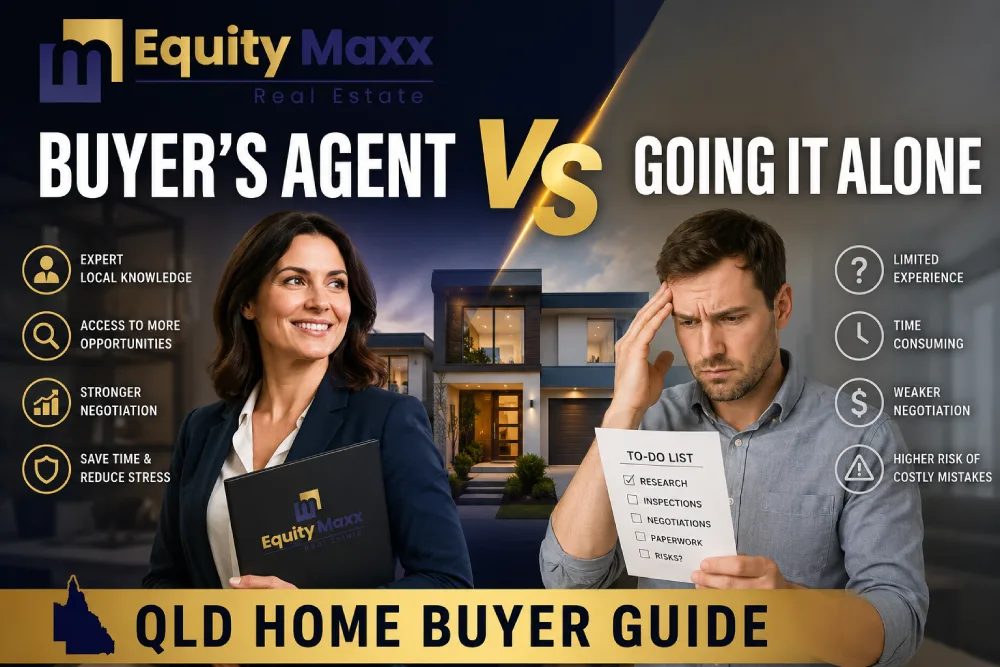
Almost every seller in Queensland is represented by an agent — but most buyers walk into the market unrepresented, negotiating directly with a professional whose sole job is to maximise the seller’s price. That structural imbalance is why buyer’s agents exist. The question isn’t whether a buyer’s agent is useful — it’s whether the value justifies the fee for your specific situation. Here’s a clear-eyed breakdown.
What A Buyer’s Agent Actually Does
- Builds a detailed brief from your needs, budget, and lifestyle goals.
- Sources properties — including off-market listings not on realestate.com.au or Domain.
- Performs suburb and property due diligence — comparable sales, growth history, flood/bushfire overlays, school catchments.
- Negotiates on your behalf with the selling agent.
- Coordinates building and pest inspections.
- Reviews contracts with your conveyancer to identify problematic special conditions.
- Manages auction bidding if applicable.
- Acts as a buffer between you and high-pressure sales environments.
What A Buyer’s Agent Costs In Queensland
Two common fee structures:
- Percentage-based fee: typically 1.5-2.5% of purchase price. On a $700,000 home, that’s $10,500-$17,500.
- Flat fee: usually $8,000-$15,000 regardless of purchase price. Common for lower-value or investment-focused briefs.
- Engagement fee: often $1,500-$3,000 upfront, credited against final fee on purchase.
When A Buyer’s Agent Earns Their Fee
1. You’re Time-Poor
Buying a home properly takes 60-120 hours of research, inspections, and negotiation over 2-6 months. If your hourly rate (or opportunity cost) exceeds $100-$150/hr, delegating to an experienced buyer’s agent often nets positive.
2. You’re New To The Queensland Market
Interstate buyers relocating to Brisbane, Springfield, or Ipswich often don’t know which streets flood, which body corporates are well-managed, which builders had problems 5 years ago, and which new estates are priced above long-term sustainable value. A local buyer’s agent has this knowledge from hundreds of transactions.
3. You’re An Investor
Investors buying for yield and growth benefit disproportionately from a buyer’s agent because the purchase is a financial decision rather than emotional. A good buyer’s agent can identify undervalued properties, avoid yield traps, and access off-market deals that DIY investors rarely see.
4. You Struggle With Negotiation
Most buyers negotiate 2-3 property purchases in their lifetime. A selling agent does it 100+ times a year. Without representation, most buyers pay $15,000-$40,000 more than they need to — often wiping out the fee of a buyer’s agent many times over.
5. You Keep Missing Out At Auction
Auctions are theatre, and experienced auctioneers exploit emotional bidding. A buyer’s agent bidding on your behalf with a pre-set limit removes the emotional trap.
When Going It Alone Makes More Sense
- You’re an experienced property buyer or investor with previous successful purchases.
- You know the specific suburb intimately (you grew up there, family lives there, etc.).
- You’re buying a new build from a developer at fixed pricing — less room for negotiation either way.
- You have plenty of time and enjoy the process.
- Your target purchase is in a market with very limited stock and little to negotiate on.
The Middle Ground — Hybrid Arrangements
- Negotiation-only service: you find the property, they negotiate for a reduced fee ($3,000-$5,000).
- Auction-only representation: they bid at auction for a flat fee ($1,000-$2,500).
- Buyer’s advocacy coaching: one or two paid consultations to give you a suburb plan and due diligence checklist.
How To Choose A Buyer’s Agent
- Check their licence — Queensland buyer’s agents must hold a Real Estate Agent licence under the Property Occupations Act.
- Ask for recent case studies — specific properties purchased, prices achieved, and time taken.
- Confirm they work independently of sellers — a good buyer’s agent never accepts commission from selling agents.
- Test their local knowledge — ask about specific streets, recent sales, and suburb-specific issues.
- Review the engagement agreement carefully — exclusivity period, fee triggers, and termination clauses.
Frequently Asked Questions
Q: How much does a buyer’s agent cost in Queensland?
A: Typical buyer’s agent fees in Queensland are 1.5-2.5% of purchase price, or flat fees of $8,000-$15,000. Most charge an upfront engagement fee of $1,500-$3,000 credited against the final fee at settlement.
Q: Is a buyer’s agent worth it for a first home buyer?
A: Often yes — first home buyers have no transaction experience and negotiate against professional selling agents. A buyer’s agent typically saves 3-5% on purchase price through negotiation and access to off-market properties, frequently exceeding the fee.
Q: Can a buyer’s agent find off-market properties in Springfield or Ipswich?
A: Yes. Established buyer’s agents have networks with selling agents, developers, and private owners that produce regular off-market opportunities in Springfield Lakes, Brookwater, Greenbank, and surrounding suburbs. Off-market deals often mean less competition and better pricing.
Q: Is a buyer’s agent the same as a real estate agent?
A: Both must hold the same Queensland Real Estate Agent licence, but they work for opposite sides. A selling agent represents the seller; a buyer’s agent represents the buyer. Using both on the same transaction is normal and gives each party representation.
Q: Do I need a buyer’s agent to buy at auction in Queensland?
A: Not legally, but it’s one of the highest-value scenarios for engaging one. Experienced buyer’s agents understand bidding psychology, pre-auction negotiation options, and post-pass-in negotiation, often saving many multiples of their fee.
Author Bio
| About The Author Written by Jinal Patel, Principal Agent and Director of EquityMaxx, based in Springfield Central. EquityMaxx offers both buyer’s agent and seller’s agent services with strict ethical separation — we never represent both sides of the same transaction. Contact us Today | 405/2 Wellness Way, Springfield Central QLD 4300 |